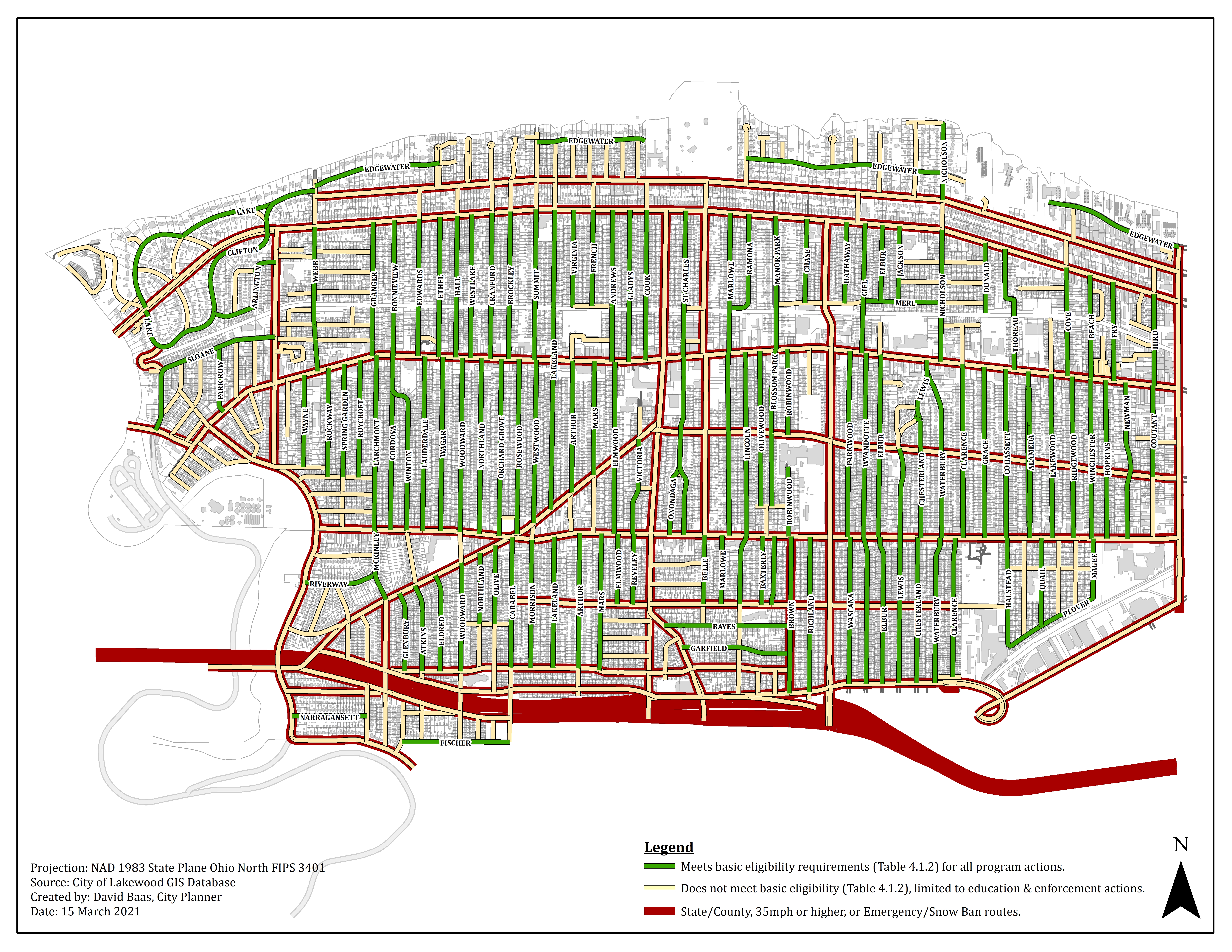
With its combination of high population density, tight grid of streets and sidewalks, and distribution of schools and parks, our City possesses a unique walkable character. Our Traffic Calming program was created to objectively respond to reports of consistent speeding and/or excessive traffic volume on our residential streets. Under this program, traffic calming implies the use of education and/or intervention actions in combination with focused enforcement to slow traffic speed and improve safety for motorists, pedestrians, and cyclists.
How Does The Program Work?
Streets are nominated by residents via the “Report-A-Problem” system. Once recieved, the nominated street is guided through a five-step process that examines the neighborhood and traffic conditions before developing a scaled and resident-supported plan of action. If education and/or enforcement actions can be effective, then the cost and permanency of intervention actions (i.e., those that physically alter the street) will be avoided unless necessary, and then only with the support of residents. While it takes only one resident to submit a complaint, building support for action among a majority of block households is important towards completing the process.
Be at least 1000 feet long (between intersections);
Have a 25 mile-per-hour speed limit;
Not be a cul-de-sac, dead end, or emergency route.
Click the image to the right to view a map that shows traffic calming eligibility of all Lakewood streets.
Step 2: Traffic Data Collection
During Step 2, we collect a few sets of traffic data on your street, separated over time. The observed traffic conditions must meet or exceed two out of the following three criteria:
Average Daily Traffic Volume of 600 or more vehicles per day.
85th percentile speed measured at 30 mph or higher.
5% or more of traffic volume at/above 35 mph.
Step 3: Plan Development
If a street qualifies, each household will then receive a notification letter providing a data summary and explaining that the development of a plan will continue based on the level of resident support for intervention actions.
Step 4: Plan Review and Approval
Resident support is measured by both a survey provided in the letter referenced in Step 3 and the option for residents to gather support from their neighbors via a petition.
If a majority (50% or more) of households support intervention actions (see below), a full plan will be developed.
If resident support does not reach the 50% level, the plan will focus only on education and enforcement actions.
Step 5: Plan Implementation
The final, approved plan is implemented.
What Type of Actions Are Typically Taken Under The Program?
Education actions provide increased awareness, reinforce the posted speed limit, and remind traffic of the importance of safe driving. Warning & radar signs are examples of education actions on several streets.
Enforcement actions provide an increased presence of law enforcement to monitor and enforce speed limits.
Intervention actions alter the roadway through marking or elements that result in lowered vehicle speeds. Speed tables offer an effective option with low (or no) impact to parking, snow plowing, or storm water drainage.